

Written by our two P 6 Learners
Angus Miller visited us to help us learn a bit more about rocks. He is a very good geologist and he studies fossils and rocks. He gave us a big rock and some magnifying glasses to look at the rock. In the rock we saw lots of fossilised shells, and the backbone of a tiny little fish and the teeth of the little fish which were absolutely minuscule.
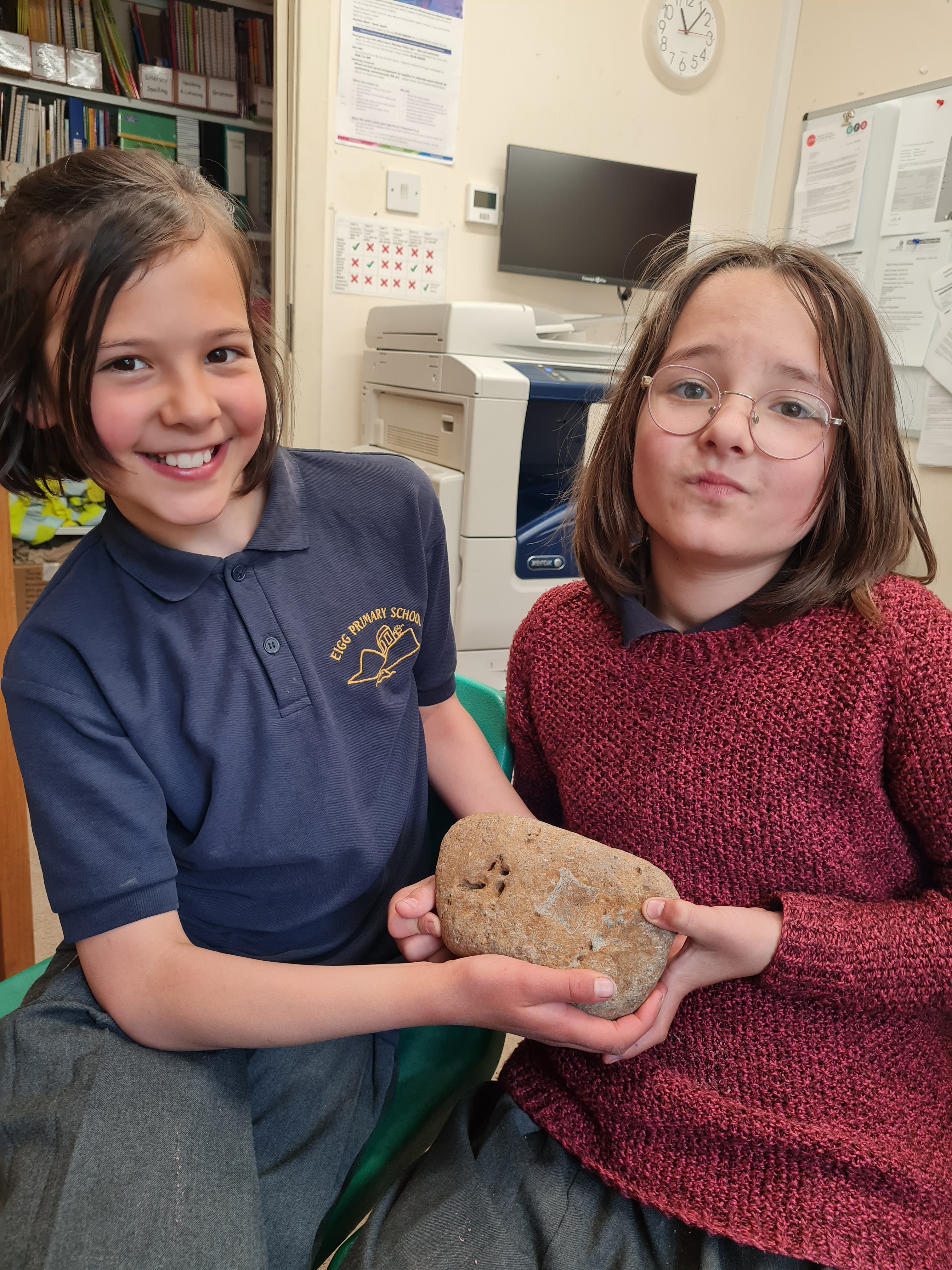
Here you can see the vertebrae of a Plesiosaur. It is a limestone.
The best place to find fossils is in the sea, because on land, if an animal dies it will erode, so it won’t really fossilize. In the sea it is going to fossilize into a rock. The rock will build up around it.
Hugh Miller is very famous. He lived in the 19th century. He did lots of work with geology and he found lots of stuff on Eigg. He used to be a potato farmer before he became a geologist. And then he decided to get into fossils. He went up the Sgurr and he found fossilized trees. He started digging the land and the people got really angry and said “you can’t do this”, but he did it anyway. He took it away with him and now we don’t know where it is. And now we do care and want to know, because it came from Eigg.
The volcano on the neighbouring Isle of Mull has made the Sgurr of Eigg. There was igneous rock and it wore away. The pitchstone in the middle is harder and is what is left.
The oldest rock came from northwest Canada. It is called agnasta gneiss.
Learning about rocks was fun and very fascinating!
A while back we had made these pamphlets of the geology of Eigg to show Angus Miller when he came in.
 eiggprimary.com